
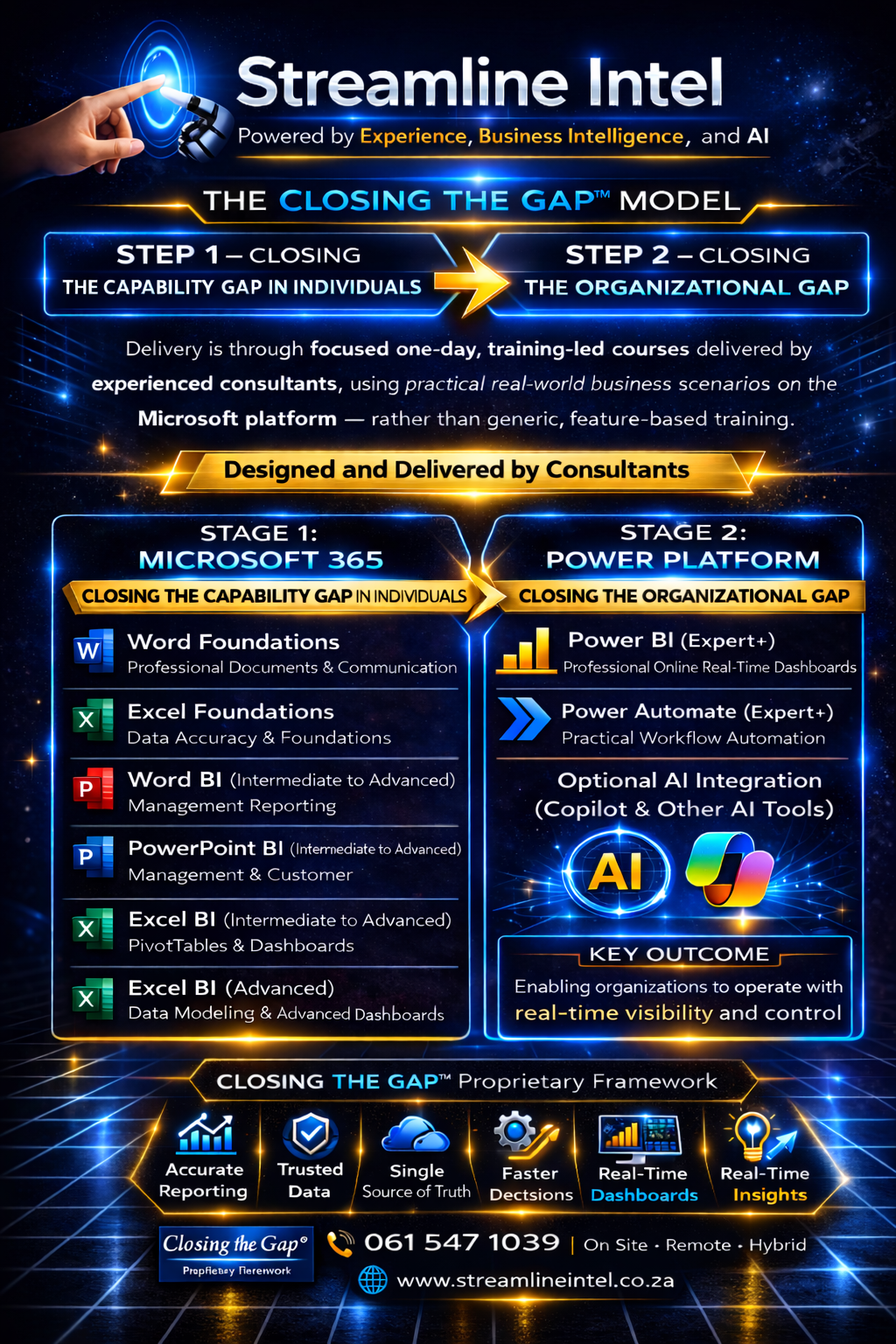
Delivering real-time visibility and control, accessible from any device, anywhere.
Why Streamline Intel?
Traditional training often stops at individual software knowledge. Streamline Intel focuses on practical business capability beyond the standard syllabus, closing gaps in individuals first and then progressing to wider organisational gaps.
Most organisations are not constrained by a lack of Microsoft tools. They are constrained by inconsistent data, fragmented reporting, manual processes, and reliance on key individuals instead of reliable systems.
Streamline Intel addresses this through a proprietary, training-led framework, Closing the Gap®, delivered through consultant-led Microsoft 365 and Business Intelligence training using real business scenarios. The focus is not generic feature-based training, but practical capability that teams understand, retain, and apply immediately.
Together, this establishes a single source of truth with trusted, connected data, integrating systems and departments through Microsoft 365 and the Microsoft Power Platform, with optional AI integration using Microsoft Copilot and other AI tools, delivering real-time visibility and control, accessible from any device, anywhere.
The result is faster, more accurate decision-making, streamlined processes, and reduced reliance on key individuals and external consultants, achieved through a structured, controlled progression.
The model is delivered through a structured two-step progression:
- Step 1, Microsoft 365 Closing the Capability Gap in Individuals
- Step 2, Microsoft Power Platform Closing the Organisational Gap
Underpinning this approach is a proprietary framework developed by Streamline Intel:
The Closing the Gap model®, developed by Streamline Intel, is a proprietary, training-led framework; while Microsoft provides the underlying technologies, the framework’s structure, content and implementation approach are original works protected by copyright.
The Closing the Gap® Model delivers: a single source of truth, connected systems and departments, real-time dashboards, reports and insights, streamlined processes, improved decision-making, and reduced reliance on key employees and external consultants.
In practice, the model moves organisations from fragmented reporting to trusted, real-time visibility and controlled workflow automation.
The model builds on existing Microsoft 365 licences, with Microsoft Power Platform, Microsoft Copilot, and other AI tools introduced only where they add clear, practical business value, ensuring a cost-effective, low-risk implementation.
This is what makes Streamline Intel different: training designed to build practical business capability, not just software knowledge.
Key Outcomes
The Closing the Gap® Model delivers measurable business outcomes across visibility, control and operational efficiency:
Real-Time Visibility
Management progressively moves away from manual, labour-intensive static reporting toward structured, trusted management information, bringing information together coherently across spreadsheets, departments, and core systems such as Finance, HR, and CRM, accessible from any device, anywhere in the world. Real-time dashboards establish a single source of truth across the organisation, providing live visibility into performance, risks, and emerging issues as they happen. Reporting delays and reliance on key individuals are removed, uncertainty is reduced, and leaders can make faster, more accurate operational and strategic decisions.
Automation & Scale
Workflow automation removes manual processes, delays, and dependency on individuals. Reporting, approvals, and data flows are automated, improving efficiency, reducing errors, and freeing up teams to focus on higher-value work. Together, real-time visibility and automation transform how organisations operate, enabling faster decisions, consistent processes, and a more scalable, controlled, and responsive business.